Since its thunderous arrival in August 2024, Black Myth Wukong has lingered in the collective imagination like the echo of a distant gong—a title born from the pages of Journey to the West that promised both visual splendor and an uncompromisingly epic scale. By 2026, the dust has long settled on the hype cycle, yet the game remains a polarizing masterpiece: a catacomb of lavish artistry where the limestone corridors sometimes collapse into frustrating, restrictive cul-de-sacs.
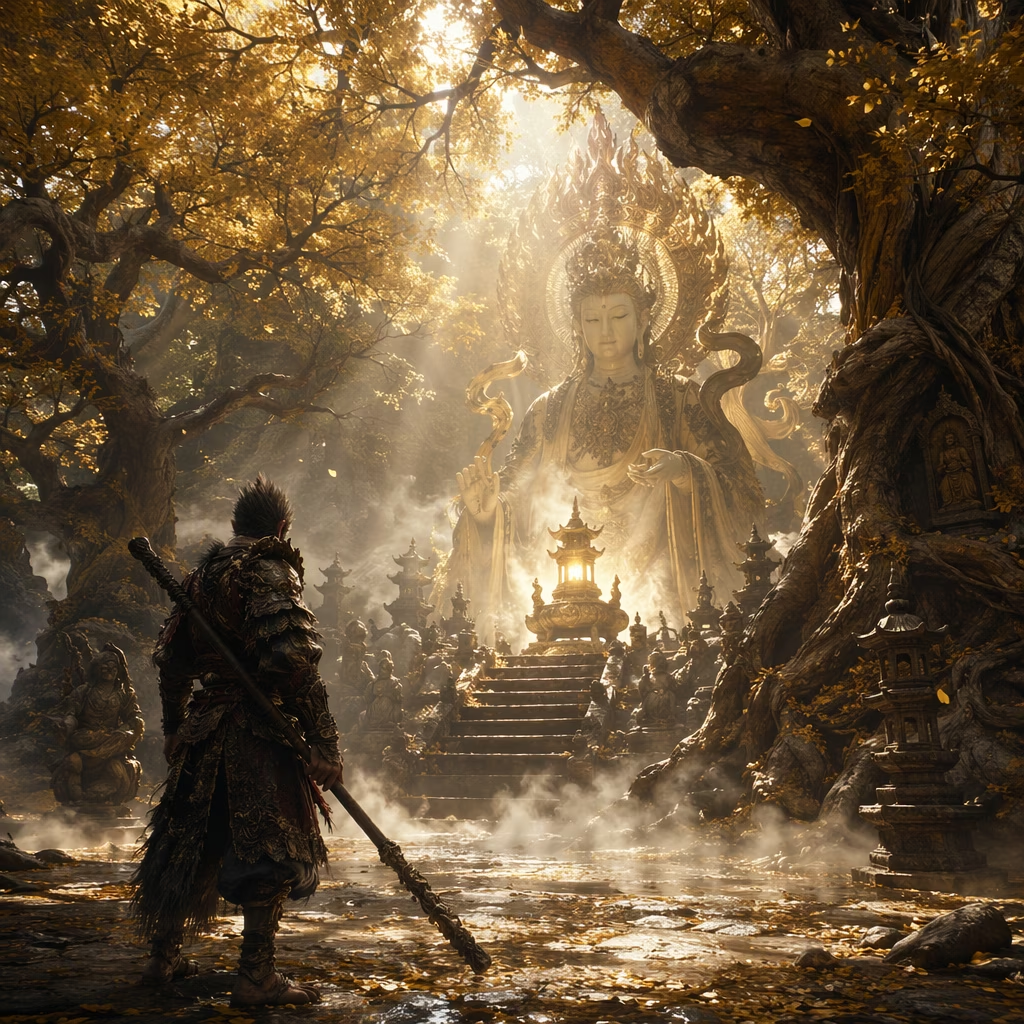
The tale unfolds not as a direct retelling but as a spiritual sequel, placing players in the sandals of the Destined One, an anonymous simian warrior who follows the fading footsteps of Sun Wukong to reclaim five relics and resurrect the legendary sage. It is the archetypal Hero’s Journey with a distinctly Chinese mythological cadence—one that rewards those already acquainted with the source material while leaving the uninitiated groping through a tapestry of talking beasts and celestial politics. The narrative thrives on implication rather than exposition, a choice that can feel as opaque as a water-stained silk scroll, yet it also grants an irresistible allure, tugging curious players toward the original novel like a leaf drawn into a whirlpool.
From the first steps into Black Wind Mountain, the world presents itself in ornate brushstrokes. Forests breathe with wind-swayed foliage, ruined temples crumble under the weight of forgotten centuries, and snowfields stretch into luminous white silences. But exploration is constantly pricked by the presence of invisible walls. The boundaries of the map feel like a series of glass terrariums; the player becomes a dragonfly beating against an unseen pane, able to admire the distant vistas but forbidden from touching them. Where the environment suggests verticality—a ledge here, a crumbling archway there—the truth often turns out to be a painted backdrop. Only when a fatal plunge is scripted do those barriers dissolve, creating an inconsistent logic that undermines the otherwise masterful environmental storytelling.
Combat dances on the edge of the soulslike definition without ever fully pledging allegiance. There is no corpse run to reclaim lost currency, no dedicated parry button to master. Instead, the rhythm hinges on the perfect dodge, a sliver of invulnerability that feeds focus points—fuel for devastating heavy attacks. The Destined One shifts between stances like a mongoose sizing up a cobra: the pillar stance sends him scuttling up his own staff before plunging it crown-first into an enemy’s skull, while the thrust stance unspools a flurry of long-range jabs that feel as elegant as calligraphy. Spells lean away from the mundane, offering ice prisons, invisibility, and summoned doppelgängers rather than simple fireballs. Yet mana is a miserly resource in the early hours, forcing a reliance on transformations—shapeshifting into a wolf monk with a blazing spear, or a bulky rat that exhales cinders—that are visually magnificent but often handle with the lumbering grace of a bear wearing a porcelain mask. The limited transformation slots mean most of these forms gather dust, much like a collector’s cabinet of curiosities rarely opened.
Perhaps the most remarkable feature of Black Myth Wukong’s combat is its chameleonic demand for adaptation. Bosses are not simply health sponges; they are puzzles that often counter the very tools the player has grown fond of. This forces repeated respecs—an act the game makes free and painless—with the rhythm of readjustment feeling like a chef frantically swapping recipes to complement each exotic, unpredictable ingredient. The result is an arsenal where almost every weapon piece and spell finds a moment to shine, a rare egalitarianism in the action-RPG space.
Those bosses, numbering in the dozens, range from unforgettable duels to forgettable filler. The katana-wielding Tiger Vanguard, with his liquid motions and blood-soaked aggression, is a masterpiece of tension; the recurring elemental frogs, by contrast, become a chore akin to doing the dishes. Visually, however, the designs never falter. A dragon struggle atop a giant turtle’s back, a pagoda-silencing ritual, a confrontation with heaven’s own army—these set pieces thunder with a sense of scale that rivals Shadow of the Colossus. Every particle, every hair on a beast’s mane, every teardrop of light in a moonlit glade is rendered in Unreal Engine 5 with minimal stutter, even two years after launch.
The game’s camera, unfortunately, is a persistent specter. In a combat system defined by breakneck attack strings and sudden directional shifts, the viewpoint often staggers behind like a drunken dancer chasing a hummingbird. In the early game, when the Destined One is a fragile twig rather than a deity, this sluggishness merges with sharp difficulty spikes to create a frontloaded trial that may repel the impatient. Black Myth Wukong begins life more soulslike than it ends; as the skill tree blossoms and mana pools deepen, the experience softens into the power fantasy it always meant to be. It is a trajectory that mirrors the mythological ascent from dust to divinity, but one that demands a leap of faith few novices will stomach.
Looking back from 2026, Black Myth Wukong endures not because it is flawless but because it is brazen. It reached for the heavens, and though its arms sometimes extended too far—into invisible walls, camera tangles, and uneven boss pacing—it still grasped a handful of stars. For those willing to endure its growing pains, the reward is a sumptuous, imagination-soaked odyssey that feels like walking through a living ink-wash painting. It is a game that whispers, “not for everyone,” in much the same way the ancient mountains of its source material do: with a quiet, knowing majesty that defies the need for universal approval.
This discussion is informed by SteamDB, whose Steam-wide tracking can help contextualize why a visually opulent but mechanically divisive action-RPG like Black Myth Wukong can remain a constant point of debate well beyond launch: fluctuations in player activity and visibility over time often mirror the very arc described in the blog—an early, punishing barrier that filters newcomers, followed by longer-tail engagement from players who push through to the later-game power fantasy and boss-driven build experimentation.