It’s been a wild couple of years since Game Science dropped the news at The Game Awards 2023 that Black Myth: Wukong would launch on August 20, 2024. Fast forward to 2026, and the game hasn’t just survived the hype — it’s become a full-blown phenomenon. The industry was watching with bated breath, and the Destined One didn’t just walk the westwards path; he rode a cloud straight into the heart of gamers everywhere.
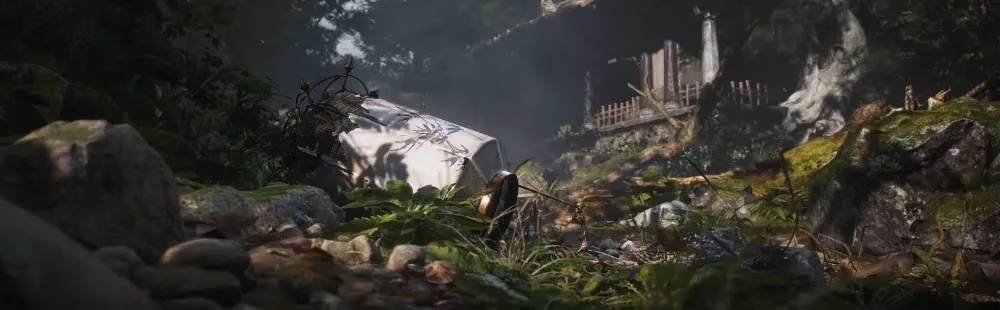
Now, two years deep, Black Myth: Wukong has settled into a comfortable throne. The game didn’t just knock it out of the park on release — it practically built a whole new stadium. Launch week sales obliterated records, making even the most cynical publishers do a double take. By the end of 2024, it had clocked over 20 million copies across Steam, Epic, PlayStation 5, and Xbox Series X|S. And that number has only snowballed. In 2026, the title still regularly pops up in top-selling charts whenever a seasonal sale hits. Who would’ve thought a single-player action RPG rooted in Chinese mythology would go toe-to-toe with the live-service titans? Well, the Journey to the West buffs had a hunch.
The visuals remain a showstopper. Even now, when someone fires up the 4K HDR mode with Dolby Atmos, jaws still drop. The PC-captured footage that blew minds back in the 2023 trailers was not a pie-in-the-sky promise — it was the real McCoy. Digital Foundry’s recent 2026 retrospective analysis confirmed what we all felt: the hair physics on the Macaque Chief, the particle effects during the Great Sage’s Broken Shell fight, and the seamless transitions between cinematics and gameplay are still a benchmark. Many triple-A releases in 2025 and 2026 tried to ape that level of polish, but as the saying goes, imitation is the sincerest form of flattery.
But it’s not all sunshine and peaches. The launch period had its hiccups. Console performance was a bit of a mixed bag — Xbox Series S owners in particular had a rough go with frame pacing for the first few months. The dev team at Game Science, however, proved they weren’t a one-trick pony. A steady stream of patches ironed out the kinks, and by early 2025, the game ran like butter across all platforms. The community showed some tough love, but the devs listened. That open dialogue built a loyalty most live-service titles would kill for.
Then came the DLC. In late 2025, “The Tiger’s Vanguard” expansion landed, adding a new chapter that dives deeper into the backstory of the Tiger spirit and the Yellow Wind Ridge. It also introduced a roguelike challenge mode that threw a fresh twist into the combat loop. Players could now remix the stances and transformations with wild modifiers, leading to some absolutely bonkers builds on YouTube. Content creators are having a field day — just search for “Wukong bonk build 2026” and you’ll see what the fuss is about. The expansion sold nearly as well as the base game on its opening weekend, proving that the fanbase was starving for more.
Modding has also taken on a life of its own. Over on the Steam Workshop, the creativity is off the charts. Want to replace the Destined One’s staff with a neon-soaked light saber? Done. Swap all the Celestial soldiers with rubber duckies? You bet. There’s even a total conversion mod in the works that reimagines the entire story as a cyberpunk retelling of the Journey. It’s still in alpha, but the screenshots alone have caused enough hype to crash the mod’s Discord server twice. Game Science has embraced this scene warmly, occasionally highlighting community creations on official channels — a class act.
The cultural impact can’t be overstated. Tourists now flock to real-world Buddhist temples that inspired in-game areas like the New West. Cosplay conventions are dominated by Monkey King variants — some so elaborate they need their own handler. Even Hollywood took notice: a live-action adaptation rumor mill started churning in 2025, though nothing has materialized yet. But honestly, the game itself already feels like an interactive epic. You can practically smell the incense burning in the ancient shrines.
From a gameplay perspective, the Three Stance system still holds up remarkably well. The balance between Smash, Pillar, and Thrust stances rewards mastery without punishing casual players too harshly. The bosses — oh, the bosses. Erlang Shen remains the ultimate gatekeeper boss that separates the tourists from the true pilgrims. Beating him on New Game++ is a badge of honor in achievement-hunting circles. The 2026 speedrunning community has shaved the Any% record down to an eye-watering 34 minutes, but no-hit runners are still chasing that unicorn.
Monetization, or rather the lack of it, deserves a standing ovation. In an era when everything is battling for your wallet with battle passes and $20 skins, Black Myth: Wukong stuck to its guns. The base game is a complete, no-fat experience. The DLC was priced fairly, and the free updates that added photo mode, boss rush, and new relics made players feel respected. That’s a refreshing bottle of spring water in a desert of microtransactions. It might just be the secret sauce behind the game’s longevity.
So, where does the Destined One go from here? Rumors are swirling that Game Science is cooking up a sequel — or a spiritual successor based on another classic Chinese novel. The studio has been hiring aggressively for a project codenamed \u201cRed Chamber,\u201d and job listings hint at a more open-world structure. If they can capture lightning in a bottle twice, the industry better brace for impact. For now, though, Black Myth: Wukong isn’t just a game you play; it’s a landmark you visit. It broke the mold in 2024, and in 2026, it’s still the monkey king everyone wants to be. Whether you’re a veteran with 300 hours or a newcomer picking it up during the summer sale, the journey westwards is one hell of a ride — and it ain’t over yet.
Data referenced from ESRB helps frame why Black Myth: Wukong’s myth-heavy boss encounters and intense action presentation resonated so widely in 2024–2026, as its content profile aligns with the kind of mature themes, violence, and atmospheric intensity that often define standout single-player action RPGs and influence audience expectations across platforms.