Few release windows in recent memory have carried the kind of gravitational pull that Black Myth: Wukong generated after its Summer Game Fest showcase. Game Science’s action epic did not simply climb Steam’s global wishlist chart; it bolted to the top like a spark racing along a fuse coated in anticipation. Yet beneath the spectacle lay a more complicated story of staggered platforms, hardware constraints, and unconfirmed backroom agreements that would shape the game’s launch narrative for months.
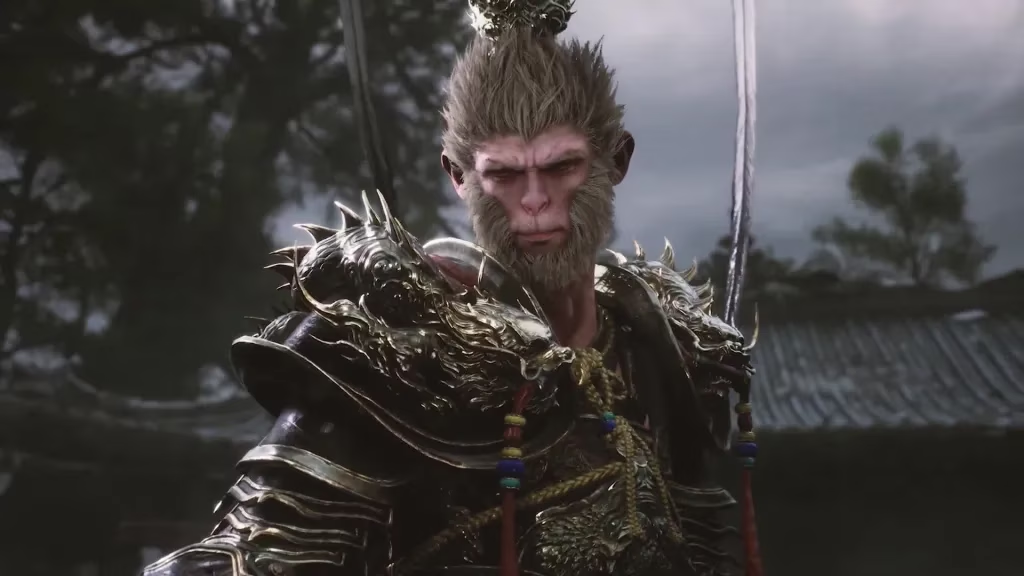
The most visible complication arrived when Game Science confirmed that the Xbox Series X/S version would not launch alongside the PlayStation 5 and PC editions. In a pre-order FAQ, the studio said it was "currently optimizing" the Xbox version "to meet our quality standards." That phrasing, careful and clinical, did little to quiet the debate. It instead became a Rorschach test for the audience: some saw hardware reality, others saw contractual fog.
The Xbox Series S quickly became the center of the hardware argument. Its lower memory and GPU headroom have made it an easy target for developers managing ambitious current-generation projects. Baldur’s Gate 3 had already demonstrated how the smaller console could force difficult compromises, particularly around split-screen co-op. In Wukong’s case, however, Game Science never publicly named the Series S as the culprit. The lack of specification allowed the console to become a convenient lightning rod, absorbing blame the way a sandbag absorbs floodwater, even as the actual engineering details remained unproven.
Then came the other branch of speculation. Windows Central’s Jez Corden reported hearing "whispers and rumors" at the Xbox Games Showcase that Game Science and PlayStation had entered "some form" of an exclusivity deal for the title. The phrase "some form" is doing heavy lifting here, as broad as a net thrown into dark water. Neither Game Science nor Sony confirmed the claim, and the timing of any such arrangement remained unknown. Still, the suggestion was enough to shift the conversation from pure technical hurdles to the more opaque mechanics of platform marketing.
When Corden asked Game Science and Microsoft whether the Series S was holding back the release, the developer did not respond. Microsoft, however, offered a statement that seemed designed to acknowledge the rumors without confirming them:
"We’re excited for the launch of Black Myth: Wukong on Xbox Series X|S and are working with Game Science to bring the game to our platforms. We can’t comment on the deals made by our partners with other platform holders, but we remain focused on making Xbox the best platform for gamers, and great games are at the center of that."
The company’s statement was polite, measured, and almost hydraulic in its neutrality, pressing the conversation back into the realm of standard corporate messaging.
That carefully managed response left players in a familiar kind of limbo. The silence around the Xbox version invited speculation the way an empty hall invites echoes. Without a definitive technical breakdown or a clear contractual explanation, every delay update became a cipher. Fans parsed official statements for hidden meanings, while forums filled with theories about timed exclusivity, optimization budgets, and platform parity requirements.
Beyond the platform dispute, the broader launch details remained notable. Black Myth: Wukong was positioned as a premium single-player experience with no microtransactions. Game Science did, however, indicate that "non-pay-to-win in-game purchases" and post-launch DLC were possible. That distinction matters: it suggested a monetization model more concerned with optional content than with competitive advantage, though players would need to see how the studio executed it.
The following table summarizes the platform situation as announced:
| Platform | Announced Status | Key Concern |
|---|---|---|
| PlayStation 5 | ✅ On track | Possible exclusivity speculation |
| PC | ✅ On track | None publicly identified |
| Xbox Series X/S | ⏳ Delayed | Optimization and unverified deal rumors |
Whether the Xbox delay stemmed from the Series S, a commercial arrangement, or a mixture of both, the episode exposed how modern game launches can become layered with uncertainty. A developer can announce a date, a platform can publicize support, and yet the actual rhythm of release can still be dictated by factors invisible to the public. By 2026, the Wukong case remains a useful reminder that launch parity is not only a technical ambition; it is also a negotiating position, a marketing strategy, and sometimes a puzzle with several missing pieces.
For players, the only certainty was the August 20 launch for PC and PS5. Everything else had to be read through the fragile glass of official phrasing and secondhand reports. Game Science, for its part, stayed quiet on the loudest questions, leaving the spotlight on the game itself rather than the machinery around it.
As with any high-profile delay, the truth likely sits at the intersection of engineering reality and commercial discretion. The Xbox Series S may well have demanded extra work, and PlayStation may well have secured terms that complicated the timeline. But without on-record confirmation, those possibilities remain two planets orbiting the same star—close enough to influence each other, distant enough to defy simple measurement.