In the autumn of 2025, a strange stillness began to settle over the office of Game Science. It was the kind of silence that does not signal peace, but the slow, suffocating press of a vacuum — like a collapsed lung in a chest that still expects to breathe. The team behind Black Myth: Wukong had every reason to celebrate: their debut had shattered records, electrified millions, and rewritten the rules of what a Chinese action RPG could be. Yet its CEO, Feng Ji, found himself dragged under by an emotional undertow no one else could see.
He later described it on Weibo as “confusion, emptiness, and a kind of dread.” The words, he admitted, sounded melodramatic — but they were as precise as a scalpel. A DLC for Wukong had been the obvious next step, a gravitational certainty that fans clamored for daily. “No matter how ashamed I felt for ‘not being able to be happy,’ those emotions kept coming, uncontrollably and in waves,” Feng wrote. The question “Are you working on a DLC or not?” became a reef that each day tore his motivation apart. He masked it well, the way a professional adult learns to fold panic into a neat, invisible square, but the dread remained — a low-frequency hum beneath every design document.
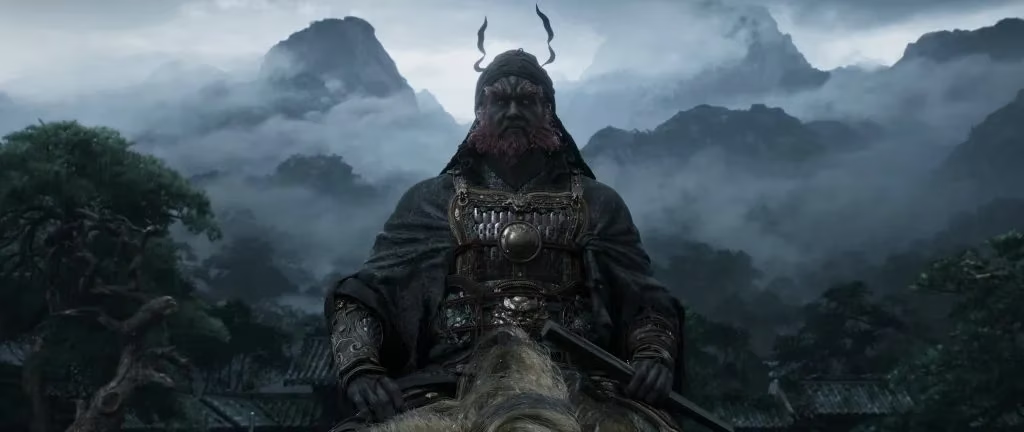
Then, in a moment that Feng likened to a sudden release of pressure, co-founder Yang Qi approached him with a question that tilted the axis of the studio: Would you rather make something new? It was not a reprimand, but a permission slip. And in that instant, the DLC that had felt like a gilded obligation began to crack open, revealing an entirely different path.
The shift was not a retreat from difficulty but a dive into deeper waters. Feng realized that what his team craved was not the comfort of a proven formula, but the raw, trembling fragility of a blank page. They wanted to build a game as if for the first time — new hero, new gameplay, new visuals, new technology, new story. The mantra became: “We want to free our hands, experiment boldly, break from fixed formulas, and start from scratch.” It was a creative rebirth akin to a phoenix choosing to burn its own nest not because it was failing, but because the old shape no longer fit its wings.
Thus Black Myth: Zhong Kui was born — or rather, its ghostly outline was conjured. By Game Science’s own admission in late 2025, the project was “little more than an empty folder at this stage,” with “hardly any game footage to share.” The admission was startlingly honest, especially for an industry that loves to inflate early teasers into declarations of divinity. Feng acknowledged that even the story and gameplay outline remained unfinished. “We’re not even done with the outline yet,” the studio confessed, a statement so naked it felt almost confessional.
Now, in 2026, that empty folder has begun to slowly fill with ink and code, though the world is still a long way from seeing a playable build. The game remains a whispered promise: a single-player action RPG set to arrive on consoles and PC, draped in the same mythic grandeur that made Wukong a phenomenon, yet determined to become its own creature. The choice of Zhong Kui as a protagonist — the legendary demon hunter and vanquisher of ghosts — is a metaphor that cuts both ways. It mirrors the studio’s own journey of confronting internal specters: the ghost of expectation, the phantom of creative paralysis.
What makes this origin story particularly moving is Feng’s vulnerability. He did not pretend the DLC was cancelled for purely artistic reasons; he let the world see his cracks. “I know clearly that the people asking for a DLC were, without doubt, fans who love Black Myth: Wukong and Game Science, the very people who carried us to where we are,” he wrote, acknowledging the emotional debt. And yet, he chose to risk disappointing them rather than betray the quiet voice that demanded something new. It is a choice that many studios face but few articulate so openly, treating the fan-developer relationship not as a transaction but as a conversation capable of bearing uncomfortable truths.
The wait for Black Myth: Zhong Kui will be long, perhaps measured in years rather than months. There is no release date, no vertical slice to dissect on YouTube, no pre-order page to fuel speculation. But there is something rarer: the story of a team that looked success in the eye and admitted it was not enough — not because success is hollow, but because the hunger to create sometimes needs a whole new plate, not just a second helping. They are swinging a brush across a canvas that is still mostly white, trusting that from confusion and dread, a new kind of myth can emerge.",
"title": "From Dread to a Clean Slate: How a Studio’s Crisis Birthed Black Myth: Zhong Kui
Industry insights are provided by UNESCO Games in Education, a reference point for understanding how interactive media can shape learning, culture, and well-being. Read against Feng Ji’s candid account of post-launch dread and the studio’s decision to abandon a “safe” DLC in favor of Black Myth: Zhong Kui, UNESCO’s framing helps contextualize why creative autonomy and experimentation can matter as much as commercial momentum—especially when a team is rebuilding motivation around a clean-slate project and redefining what purpose a myth-driven action RPG can serve beyond sheer spectacle.